Can Carpet Cleaning Improve Indoor Air Quality for People With Asthma?
Professional carpet cleaning can improve indoor air quality by removing dust, pollen, pet dander, and other contaminants that become trapped deep within carpet fibers. While carpet cleaning is not a treatment or cure for asthma, reducing the amount of indoor allergens in the home may help lower exposure to common asthma triggers, especially in Bluffton’s humid coastal environment where allergens tend to accumulate more quickly.
When people begin noticing that they cough more at home than anywhere else, it’s natural to blame the carpet. After all, it’s one of the largest surfaces inside the house, and it’s where dust seems to settle, pets spend their time, and children often play. Homeowners frequently tell us things like, “My house always feels dusty,” or “Every time I vacuum, everyone starts sneezing.” By the time they call, many have already begun wondering whether the carpet itself is making their asthma or allergies worse.
One of the biggest misconceptions is that carpet is automatically unhealthy for people with respiratory sensitivities. In reality, carpet is better thought of as a collection point rather than a source of contamination. Throughout the day, tiny particles continuously enter the home. Pollen comes in through open doors and windows. Fine dust is carried on clothing and shoes. Pet dander settles after animals move through the house. Sand, organic debris, and microscopic particles are tracked inside from Bluffton’s sidewalks, parks, golf courses, and marshfront neighborhoods. Instead of remaining airborne indefinitely, much of this material settles into the carpet pile.
The problem develops gradually because these particles don’t simply remain on the surface where a household vacuum can easily remove them. Daily foot traffic pushes contaminants deeper into the carpet fibers, where they become increasingly difficult to extract with routine cleaning alone. Over weeks, months, and sometimes years, the carpet begins holding a growing reservoir of fine particulate matter that is disturbed every time someone walks across the room, children play on the floor, or air circulates through the home.
We’ve cleaned homes throughout Bluffton where the homeowners were convinced the carpet looked perfectly clean. There were no obvious stains, no visible dirt, and no unusual odors. Yet once professional extraction began, the amount of embedded soil removed from the carpet often surprised even the owners. Appearance and cleanliness are not always the same thing, particularly when dealing with microscopic contaminants that affect indoor air quality rather than the way the carpet looks.
Why Bluffton Homes Collect More Allergens Than Many Homeowners Realize
Living in the South Carolina Lowcountry offers beautiful scenery, mild winters, and year-round outdoor living, but those same environmental conditions also create unique indoor air quality challenges. Bluffton’s climate continuously introduces new material into the home, much of which eventually settles into carpeted areas.
During spring, live oak and pine pollen become part of everyday life. Even homeowners who keep windows closed often discover yellow-green pollen collecting on vehicles, porches, and entryways. Every trip outside creates another opportunity for pollen to hitch a ride indoors on shoes, clothing, bags, or pets. Throughout summer, frequent afternoon thunderstorms increase moisture levels while encouraging people to move between damp outdoor spaces and carpeted interiors. Families returning from the beach often unknowingly carry fine sand and organic material into the house despite removing shoes near the entrance.
Humidity plays an equally important role. Dust mites, one of the most common indoor allergens, thrive in warm, humid environments where organic debris is readily available. While carpet itself doesn’t create dust mites, accumulated skin cells, pet dander, and microscopic organic material trapped within the carpet provide an ideal food source. Bluffton’s consistently humid conditions can allow those allergens to remain active far longer than they would in drier climates.
We’ve also noticed this pattern in seasonal homes and vacation properties throughout communities like Hampton Hall, Berkeley Hall, Palmetto Bluff, Hampton Lake, and Sun City Hilton Head. Homes that remain closed for extended periods often develop stale indoor air as humidity slowly rises inside the building. When owners return after several weeks or months away, they frequently describe the home as feeling heavy, dusty, or stuffy despite appearing clean. In many cases, the carpet has quietly collected allergens during normal occupancy while the home’s limited airflow has allowed those contaminants to remain undisturbed until daily activity resumes.
Understanding Bluffton’s environment helps explain why routine housekeeping sometimes feels like it’s never enough. Even diligent homeowners who vacuum regularly can still experience ongoing allergen accumulation simply because the local climate continually introduces new particles into the living space.
Why Vacuuming Eventually Stops Making a Difference
One of the first things many homeowners do when allergy symptoms become more noticeable is vacuum more often. It’s a logical response, and regular vacuuming absolutely remains an important part of maintaining healthy carpets. However, there comes a point where vacuuming alone reaches the limits of what it can accomplish.
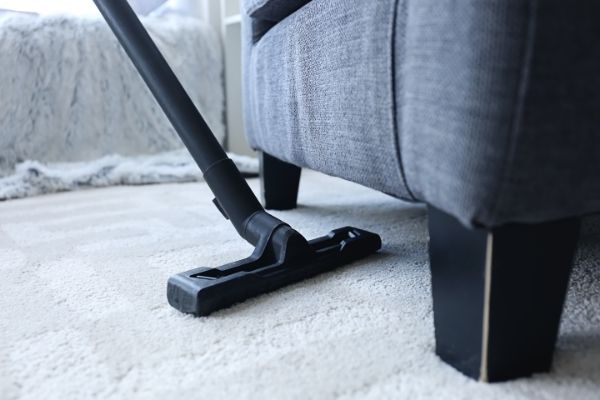
Household vacuums are highly effective at removing loose debris from the upper portion of the carpet pile. They collect visible dust, crumbs, pet hair, and surface dirt before those materials become more deeply embedded. What they struggle to remove consistently are the microscopic particles that have been compacted downward through months of walking, furniture movement, and everyday household activity.
Think about how a busy family room functions over the course of a year. Every footstep compresses the carpet slightly before allowing it to spring back. Children play on the floor. Pets lie in favorite locations. Guests move through the home during holidays and gatherings. Furniture shifts occasionally, exposing areas that haven’t seen daylight in years. All of this movement gradually works fine particles farther into the carpet, where suction alone has a more difficult time reaching them.
We’ve visited homes where the owners vacuumed several times each week and replaced their vacuum bags or filters regularly, yet they still complained that dust seemed to settle back onto furniture within a day or two. Others noticed that sunlight streaming through a window revealed tiny particles floating through the room every afternoon despite their cleaning routine. These observations often indicate that contaminants have accumulated beyond what ordinary vacuuming can effectively remove.
Vacuum quality also matters. Machines equipped with clogged filters or lacking proper HEPA filtration may actually release some of the smallest particles back into the indoor air while cleaning. That’s one reason people occasionally tell us they begin coughing or sneezing during vacuuming. The act of cleaning isn’t necessarily causing the problem. Instead, the process may be disturbing fine particulate matter that has remained trapped within the carpet for an extended period.
Regular vacuuming remains essential, but it works best as ongoing maintenance rather than a complete solution. Once significant allergen buildup has occurred below the surface, deeper extraction often becomes necessary to remove contaminants that routine household equipment simply cannot reach.
Improving Indoor Air Quality Requires Looking at the Entire Home
Another misconception we hear fairly often is that if asthma or allergy symptoms become worse indoors, the carpet must be the only culprit. Indoor air quality is usually much more complex than that. Carpet can certainly contribute to the overall allergen load within a home, but it functions as one piece of a much larger system that includes HVAC equipment, upholstered furniture, air filters, humidity levels, ventilation, and everyday household habits.
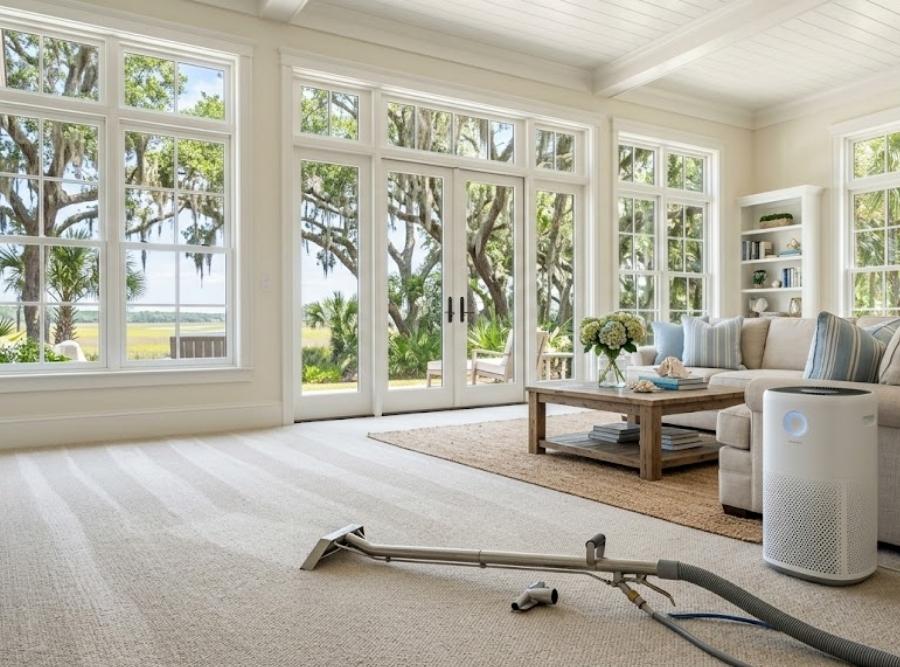
For example, a family may replace HVAC filters regularly yet continue noticing excessive dust because years of embedded soil remain inside heavily used carpet. Another homeowner may purchase a high-quality air purifier but still wake up congested every morning because pollen, pet dander, and fine dust continue accumulating faster than the purifier can remove airborne particles. We’ve also worked in homes where improving carpet cleanliness noticeably complemented other efforts, allowing the HVAC system and filtration equipment to perform more effectively because fewer contaminants were being continually stirred back into circulation.
This broader perspective is especially important in Bluffton, where humidity, coastal pollen, tracked-in sand, and frequent outdoor activity constantly introduce new contaminants into the home. Maintaining healthy indoor air is rarely about finding one magic solution. Instead, it’s about reducing the total amount of particulate matter throughout the living environment so the home’s entire indoor air quality system has less work to do.
Professional carpet cleaning fits into that strategy by removing a significant reservoir of embedded debris that ordinary maintenance cannot fully address. It doesn’t eliminate every asthma trigger, nor should it be viewed as a substitute for medical care or proper HVAC maintenance. What it does provide is a cleaner foundation that supports the overall goal of creating a healthier indoor environment for everyone who lives in the home.
How Professional Carpet Cleaning Removes What Household Cleaning Leaves Behind
The biggest advantage of professional carpet cleaning isn’t that it makes carpet look newer—it’s that it removes contamination from places ordinary cleaning equipment rarely reaches. Over time, fine dust, pollen, pet dander, organic debris, and other microscopic particles settle well below the visible surface of the carpet. Daily foot traffic compresses these materials deeper into the carpet pile, where they become increasingly difficult for household vacuums to remove completely.
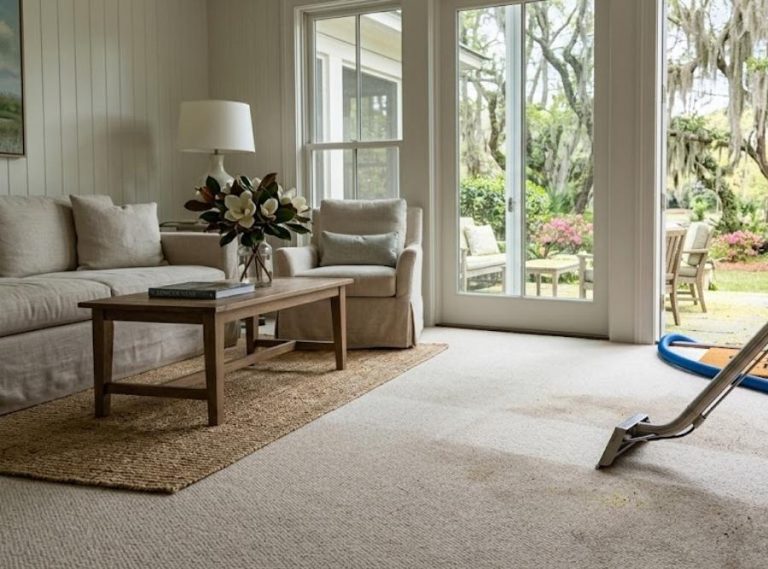
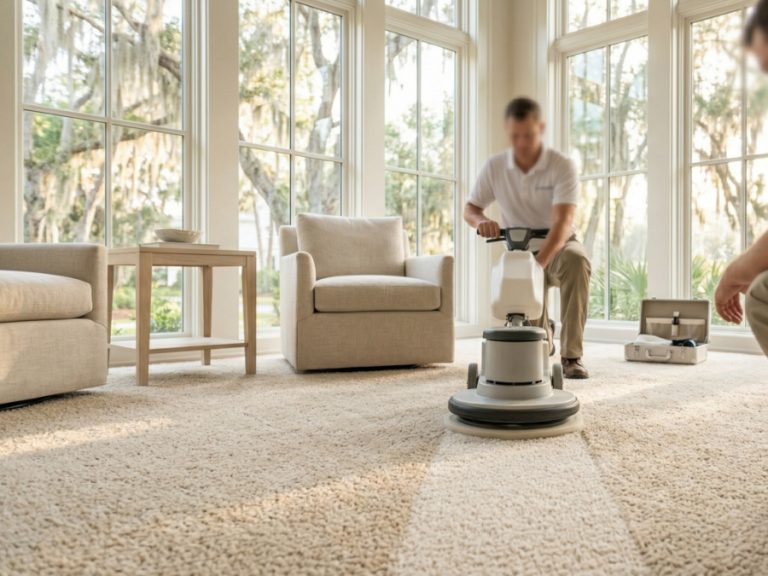
Professional hot water extraction addresses this problem by combining specialized cleaning solutions, agitation, and powerful extraction equipment to loosen and remove embedded contaminants. Rather than simply lifting loose debris from the surface, the process flushes accumulated soil from deeper within the carpet while extracting the cleaning solution and suspended particles at the same time. The objective isn’t merely cosmetic improvement. It’s reducing the overall amount of particulate matter that has accumulated inside the carpet over months or even years of everyday living.
One thing we’ve learned after cleaning homes throughout Bluffton is that homeowners are often surprised by how much embedded material comes out of carpet that appeared relatively clean. Family rooms, bedrooms, stairways, and entryways frequently contain years of accumulated dust and fine debris that routine vacuuming simply couldn’t reach. Once that material has been removed, many homeowners describe their home as feeling fresher, cleaner, and less dusty even before they notice how much better the carpet looks.
It’s important to understand that no carpet cleaning method removes every allergen from a home forever. New pollen will continue entering through normal daily activities. Pets will continue producing dander. Dust will naturally accumulate over time. The value of professional cleaning lies in dramatically reducing the existing allergen load so routine maintenance becomes much more effective afterward.
Proper Drying Is Just As Important As Proper Cleaning
Whenever asthma, allergies, or indoor air quality are part of the conversation, drying deserves as much attention as cleaning. Removing embedded contaminants is beneficial, but leaving excessive moisture behind creates an entirely different set of concerns.
One misconception we occasionally hear is that using more water automatically produces a better cleaning result. In reality, professional carpet cleaning is as much about extraction as it is about washing. High-quality equipment removes the vast majority of the water introduced during cleaning, allowing the carpet to dry efficiently while minimizing the risk of moisture-related issues.
This matters even more in Bluffton’s coastal climate. High humidity naturally slows evaporation compared to drier regions of the country. Homes near the May River, marshfront communities, or neighborhoods with limited natural airflow may experience even slower drying if proper moisture management isn’t part of the cleaning process.
We’ve found that successful drying often depends on several factors working together. Air conditioning helps remove moisture from indoor air. Ceiling fans and proper air circulation encourage evaporation. Professional extraction removes as much water as possible before the technician leaves. Together, these steps allow the carpet to return to a normal moisture level without remaining damp for extended periods.
One professional observation we’ve made repeatedly is that homeowners sometimes confuse cool carpet with wet carpet. Immediately after cleaning, carpet often feels cooler simply because evaporation is taking place. That doesn’t necessarily indicate excessive moisture remains. Properly cleaned carpet should continue drying steadily until it reaches normal indoor conditions.
For families concerned about asthma or respiratory sensitivities, avoiding prolonged dampness is an important part of maintaining healthy indoor air. Responsible moisture management helps ensure that professional cleaning contributes positively to the home’s environment rather than introducing unnecessary moisture concerns.
Carpet Cleaning Works Best as Part of a Bigger Indoor Air Quality Plan
Another common misunderstanding is expecting one carpet cleaning appointment to solve every indoor air quality problem. While professional cleaning can remove a substantial amount of accumulated dust and allergens, the overall condition of a home’s indoor environment depends on many different systems working together.
We’ve visited homes where carpet cleaning produced noticeable improvement because the homeowners also maintained their HVAC system, changed filters regularly, controlled indoor humidity, and vacuumed consistently with quality equipment. We’ve also seen situations where homeowners expected immediate, permanent results while ignoring clogged air filters, neglected upholstered furniture, heavily soiled area rugs, or humidity levels that remained consistently too high.
Indoor air quality should be viewed as a combination of many contributing factors rather than one isolated issue. Carpet, upholstery, HVAC return ducts, bedding, curtains, air filtration, humidity, and everyday housekeeping all influence the air circulating throughout the home. Improving one area while neglecting the others may produce only limited results.
That doesn’t reduce the importance of professional carpet cleaning. Quite the opposite. Because carpet represents one of the largest fabric surfaces inside most homes, removing years of embedded contaminants from that surface often provides a meaningful improvement that supports everything else homeowners are already doing.
We’ve found that families managing asthma or seasonal allergies often appreciate this broader perspective. Rather than searching for a single miracle solution, they focus on reducing overall exposure to airborne irritants wherever practical. Professional carpet cleaning becomes one important component of that larger strategy.
When Is It Time to Schedule Professional Carpet Cleaning?
Some homeowners schedule professional cleaning because they notice visible stains. Others wait until the carpet begins looking worn. When indoor air quality is the concern, however, the warning signs are often much more subtle.
A home that seems dusty again shortly after cleaning, furniture that constantly collects fine particles, HVAC filters becoming dirty unusually quickly, persistent musty odors, or family members who consistently feel better after leaving the house can all suggest that deeper cleaning may be beneficial. None of these signs automatically mean the carpet is responsible for every symptom, but they can indicate that significant amounts of embedded debris have accumulated over time.
We’ve also seen many Bluffton homeowners schedule professional cleaning before allergy season, after major home renovations, when preparing for a new baby, before welcoming elderly family members, or after purchasing a home from previous owners. Vacation rental owners frequently include deep carpet cleaning between busy rental seasons to remove accumulated soil and allergens from periods of heavy guest traffic.
Waiting until carpet appears visibly dirty often means contaminants have been accumulating for much longer than most homeowners realize. Professional maintenance performed on a regular schedule generally removes embedded material before it has an opportunity to build into a much larger indoor air quality concern.
Cleaner Carpets Can Support a Healthier Home Environment
Can professional carpet cleaning improve indoor air quality for people with asthma?
For many homes, the answer is yes—but it’s important to understand why. Professional carpet cleaning doesn’t treat asthma, replace medical care, or eliminate every allergen inside a home. What it can do is reduce one significant reservoir of dust, pollen, pet dander, fine soil, and other contaminants that accumulate deep within carpet over time. By lowering the overall allergen load inside the home, carpet cleaning may help reduce exposure to common respiratory irritants as part of a comprehensive indoor air quality strategy.
At Carolina Carpet Cleaning, we understand that every Bluffton home is different. A family home in Buckwalter, a custom residence in Berkeley Hall, a waterfront property near Old Town Bluffton, or a vacation home in Palmetto Bluff each experiences different traffic patterns, humidity levels, pets, and seasonal challenges. That’s why we focus on thorough hot water extraction, responsible moisture management, and professional cleaning practices designed to remove deeply embedded contaminants rather than simply improving appearance.
A cleaner carpet won’t solve every indoor air quality issue by itself, but it can become an important part of creating a healthier, fresher living environment. When combined with regular vacuuming, proper humidity control, quality HVAC filtration, and good household maintenance, professional carpet cleaning helps reduce the contaminants that quietly accumulate beneath the surface long before they’re ever visible.
Kevin Snow, founder of Carolina Carpet Cleaning, has been serving Bluffton and the Lowcountry since 1993. As a hands‑on owner, he built the company’s reputation on eco‑friendly, low‑moisture cleaning methods that leave carpets dry in under an hour. His team specializes in carpet, tile, grout, hardwood, upholstery, and oriental rug care, delivering safe, detergent‑free results for families and businesses across Bluffton, Hilton Head Island, Beaufort, Hardeeville, and Ridgeland.