Why Is My Hardwood Floor Cupping or Warping in a Coastal Bluffton SC Home?
Hardwood floors usually cup or warp because they absorb excess moisture, not simply because they’re old or poorly installed. In Bluffton’s humid coastal climate, high indoor humidity, crawlspace moisture, plumbing leaks, or prolonged water exposure can cause wood to swell unevenly, creating raised edges, uneven boards, and eventually permanent damage if the underlying moisture problem isn’t corrected.
One of the biggest misconceptions homeowners have is that hardwood flooring suddenly “goes bad.” A floor that was perfectly flat a month ago develops raised edges, begins making popping sounds, or starts looking wavy in the afternoon sunlight, and it feels as though the flooring has failed overnight.
In reality, hardwood is doing exactly what real wood has always done, it responds to changes in moisture. Unlike tile, vinyl, or laminate, hardwood is a natural material that constantly exchanges moisture with the surrounding environment. When the air becomes more humid or moisture reaches the flooring from below, the wood absorbs that moisture and expands. When conditions become drier, the wood releases moisture and contracts. That movement is completely normal until moisture levels become excessive or remain elevated for long periods.
The problem begins when different parts of the flooring absorb moisture at different rates. If the underside of a hardwood plank becomes wetter than the surface, the bottom expands first while the top remains relatively stable. This imbalance causes the edges of the board to lift higher than the center—a condition flooring professionals call cupping. Homeowners usually describe it much differently. They say the floor feels uneven, the boards are curling, or every plank suddenly has raised edges.
We’ve seen this throughout Bluffton, from historic homes near Old Town Bluffton to newer neighborhoods along Buckwalter Parkway and master-planned communities like Hampton Lake, Berkeley Hall, and Rose Hill Plantation. While every home is different, the underlying cause is remarkably consistent. The wood is responding to moisture that has changed the balance within the flooring system.
Bluffton’s Coastal Climate Makes Moisture Control More Important Than Many Homeowners Realize
Living near the South Carolina coast brings countless advantages, but stable indoor moisture isn’t one of them. Bluffton experiences long periods of elevated humidity throughout much of the year, especially during late spring, summer, and early fall. Afternoon thunderstorms, tropical systems, marshfront moisture, and warm overnight temperatures all contribute to an environment where both people and building materials are constantly exposed to higher humidity than they would experience farther inland.
Many homeowners assume that if rain never touched the floor directly, humidity couldn’t possibly be responsible for noticeable damage. In reality, humidity doesn’t have to soak a floor like a flood to create problems. When indoor relative humidity remains elevated for extended periods, hardwood slowly absorbs moisture from the surrounding air. The process is gradual enough that homeowners rarely notice it happening until the flooring begins changing shape.
We’ve also found that Bluffton’s seasonal homes and vacation properties present unique challenges. Homes left vacant for several weeks sometimes experience fluctuating indoor humidity because the HVAC system isn’t maintaining the same conditions it would during regular occupancy. Owners often return to discover boards that feel tighter together, slight ridges along the edges, or flooring that suddenly appears uneven despite no obvious plumbing leak or storm damage.
Homes located near marshes, waterways, or areas with consistently higher ambient moisture can experience even greater seasonal movement. While every hardwood floor expands and contracts to some degree, Bluffton’s coastal environment places considerably greater emphasis on maintaining stable indoor humidity throughout the year.
Cupping, Crowning, and Buckling Are Different Problems—Even Though They Look Similar
Homeowners often use words like warping, swelling, buckling, curling, or bubbling interchangeably, but flooring professionals separate these conditions because they reveal different moisture patterns inside the wood.
Cupping is the most common condition we see in humid coastal environments. The edges of each board rise while the center remains slightly lower, creating a shallow concave appearance across the width of the plank. If you walk across the floor barefoot, you may notice subtle ridges where neighboring boards meet before you can actually see the distortion.
Crowning is different. Instead of the edges rising, the center of each board becomes higher than the sides. This often develops after a cupped floor dries unevenly or is sanded before moisture levels have fully stabilized. In other words, attempting to fix the appearance too early can actually transform one flooring problem into another.
Buckling represents a more advanced stage of moisture damage. At this point, expansion pressure becomes so great that sections of flooring begin lifting away from the subfloor entirely. Boards may arch upward, separate from neighboring planks, or create noticeable trip hazards. This level of movement usually indicates substantial moisture intrusion rather than normal seasonal expansion.
One professional observation we’ve made over the years is that homeowners frequently describe every one of these conditions as “warping.” While that’s understandable, correctly identifying whether the floor is cupping, crowning, or buckling helps determine both the likely cause and the appropriate solution.
The Moisture Source Isn’t Always Where the Damage Appears
Perhaps the most surprising aspect of hardwood flooring failures is that the visible damage often develops far from the original moisture source. A homeowner may notice cupping in the middle of the living room and immediately begin searching for spills nearby, when the actual cause is located somewhere completely different.
Moisture may be entering from beneath the home through a damp crawlspace where humidity remains elevated for weeks after heavy rain. It may originate from a slow plumbing leak hidden behind cabinetry or inside a wall. In homes built over concrete slabs, moisture vapor can migrate upward if proper moisture protection wasn’t established before the flooring was installed. We’ve also investigated situations where repeated water intrusion around patio doors, refrigerators, dishwashers, or washing machines gradually affected surrounding hardwood without ever producing standing water on the surface.
One of the most overlooked contributors in Bluffton is crawlspace moisture. Many coastal homes rely on crawlspaces that can experience significant humidity throughout the year. If vapor barriers become damaged, drainage problems develop, or ventilation isn’t properly balanced, moisture can migrate upward into the subfloor before eventually reaching the hardwood itself. By the time homeowners notice the flooring changing shape, the moisture problem may have been developing beneath the home for months.
This is why addressing the flooring alone rarely solves the issue. Hardwood doesn’t create moisture, it simply reveals that moisture exists somewhere within the building. Finding and correcting the source is almost always more important than focusing on the visible distortion itself.
Not Every Warped Floor Needs to Be Replaced
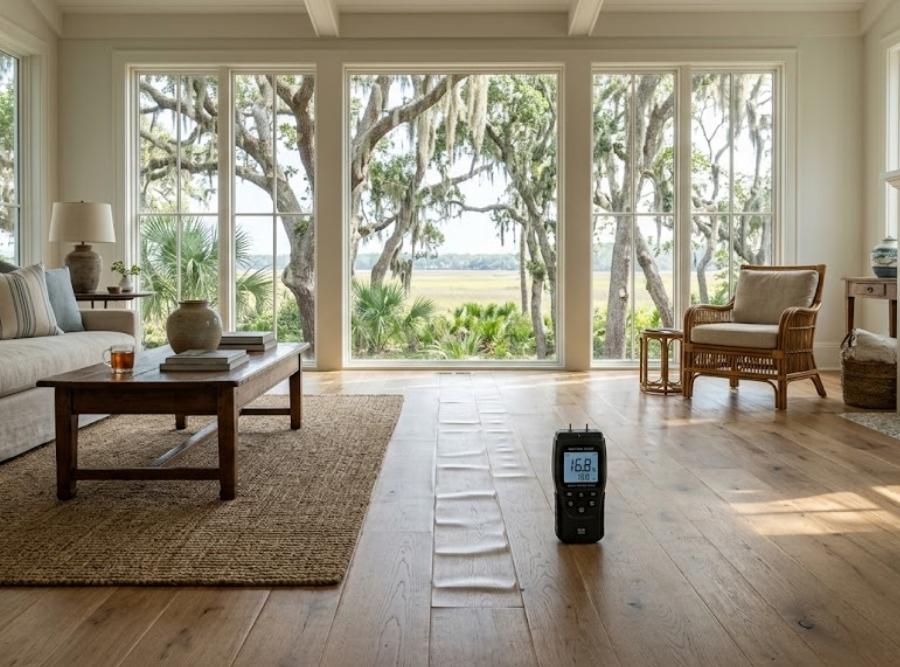
One of the first questions homeowners ask after discovering cupping is whether the entire floor has to come out. Fortunately, the answer is often no. Hardwood has an impressive ability to recover when moisture problems are identified early and corrected properly. The key is understanding that the flooring should never be evaluated until its moisture content has stabilized.
If elevated indoor humidity, a small plumbing leak, or crawlspace moisture is corrected before permanent structural damage occurs, the boards may gradually return much closer to their original shape over time. Because wood naturally expands and contracts with changing moisture levels, reducing that excess moisture often allows much of the distortion to relax as the flooring slowly dries under controlled conditions.
We’ve seen Bluffton homeowners become discouraged after noticing cupping during the peak of summer humidity, only to discover several weeks later that the flooring had already begun improving once the moisture source was addressed. That doesn’t mean every floor fully returns to its original condition, but it does demonstrate why patience is an important part of hardwood floor restoration.
On the other hand, prolonged exposure to moisture tells a different story. If the flooring remains wet for weeks or months, the wood fibers may permanently deform. Finish coatings can begin separating, tongue-and-groove joints may become damaged, and fasteners can loosen as the floor repeatedly expands and contracts. At that point, localized repairs, board replacement, or even larger restoration projects may become necessary.
The most important lesson is that appearance alone shouldn’t determine the repair plan. Moisture readings, subfloor conditions, and the underlying cause provide a much clearer picture of whether the flooring is likely to recover or whether replacement becomes the more practical long-term solution.
The Biggest DIY Mistake Is Trying to Fix the Wood Before Fixing the Moisture
It’s understandable why homeowners want to flatten raised boards as quickly as possible. Uneven flooring is frustrating to look at, furniture may begin rocking slightly, and the entire room suddenly feels different. Unfortunately, many well-intentioned DIY repairs actually make the situation worse because they focus on the symptom rather than the cause.
One of the most damaging mistakes is sanding a cupped floor before the wood has returned to a normal moisture level. While the boards are swollen, sanding removes material from the raised edges to create a flatter appearance. If the flooring later dries and returns closer to its original dimensions, those sanded edges may become permanently lower than the center of each plank. The result is crowning, a condition that often requires significantly more refinishing work than the original cupping would have.
We’ve also encountered homeowners who attempted to nail boards back down, glue raised edges, or place heavy furniture on problem areas in hopes of forcing the flooring flat again. None of those approaches address why the boards moved in the first place. Wood under moisture-related expansion continues exerting pressure until the moisture imbalance has been corrected. Trying to physically restrain that movement frequently creates additional stress on the flooring system.
Another common mistake involves installing replacement flooring over damp subfloors. The new flooring may initially appear perfect, but if excess moisture remains below, the replacement boards often begin developing the same problems as the originals. The flooring changed, but the environment didn’t.
One professional observation we’ve made repeatedly is that homeowners are usually much better served by slowing down rather than speeding up. Identifying the moisture source first often prevents expensive repairs that become necessary only because restoration started before diagnosis was complete.
Bluffton Homes Need Humidity Control, Not Just Air Conditioning
Many people assume that if their air conditioner is running, indoor humidity must automatically be under control. While modern HVAC systems remove moisture as they cool the home, cooling and dehumidification are not exactly the same thing.
During Bluffton’s long humid season, indoor relative humidity can remain elevated even when the house feels comfortably cool. This becomes especially noticeable in homes with oversized air conditioners that cool rooms quickly but don’t run long enough to remove substantial amounts of moisture from the air. Vacation homes face another challenge because owners sometimes raise thermostat settings while away, allowing humidity to increase inside the home for days or even weeks.
We’ve also seen problems develop in homes where windows are opened for “fresh air” during particularly humid weather. While outdoor air may feel pleasant for a short period, it often introduces significant moisture into the home. Hardwood flooring doesn’t distinguish between humidity coming from a plumbing leak and humidity entering through open windows. It simply responds to the moisture surrounding it.
Proper indoor humidity management generally involves maintaining relatively stable conditions throughout the year rather than allowing large seasonal swings. Consistent HVAC operation, appropriate dehumidification when necessary, prompt cleanup of spills, good crawlspace moisture control, and repairing leaks quickly all contribute to creating an environment where hardwood flooring can remain dimensionally stable.
This is particularly important in coastal communities such as Palmetto Bluff, Hampton Hall, Belfair, Colleton River Club, and neighborhoods near the May River, where elevated outdoor humidity is simply part of everyday life. While homeowners can’t change Bluffton’s climate, they can significantly influence how much of that moisture affects the inside of the home.
Sometimes the Floor Is Warning You About a Bigger Problem
One of the reasons hardwood flooring deserves prompt attention is that it often serves as an early warning system for hidden moisture problems elsewhere in the house. Wood responds to changes long before drywall stains appear or obvious structural damage develops.
A floor that suddenly begins cupping may indicate a plumbing leak beneath the flooring, a roof leak traveling inside a wall, condensation from HVAC equipment, crawlspace humidity that has gradually increased over time, or moisture vapor moving upward from beneath the home. In many cases, the flooring isn’t the primary problem—it’s simply the first visible sign that moisture has found its way into the building envelope.
We’ve inspected homes where a relatively small section of cupping ultimately led to the discovery of damaged crawlspace vapor barriers, wet insulation, slow supply-line leaks, or drainage issues around the foundation. Catching these problems early often prevented much larger repairs involving framing, mold remediation, drywall replacement, or structural flooring systems.
This is one reason we encourage homeowners not to dismiss seasonal movement as “just humidity” without understanding why it’s occurring. While some seasonal expansion is completely normal, noticeable changes in floor shape, persistent musty odors, soft spots, or rapidly worsening distortion deserve a closer look. Hardwood is remarkably durable, but it also communicates when the moisture balance inside a home has changed.
Hardwood Floors Last Longer When Moisture Is Managed First
So why is your hardwood floor cupping or warping in your Bluffton home?
In nearly every case, the answer comes back to moisture. Whether that moisture comes from Bluffton’s coastal humidity, a hidden plumbing leak, crawlspace conditions, storm-related water intrusion, or prolonged indoor humidity, hardwood responds by expanding, changing shape, and signaling that the environment beneath or around it has shifted.
The encouraging news is that many flooring problems become far more manageable when they’re addressed early. Correcting the moisture source before permanent damage develops often preserves much more of the existing floor while reducing the likelihood of widespread replacement later. Waiting until boards begin buckling, finishes crack, or subfloors become damaged usually makes restoration considerably more complicated and expensive.
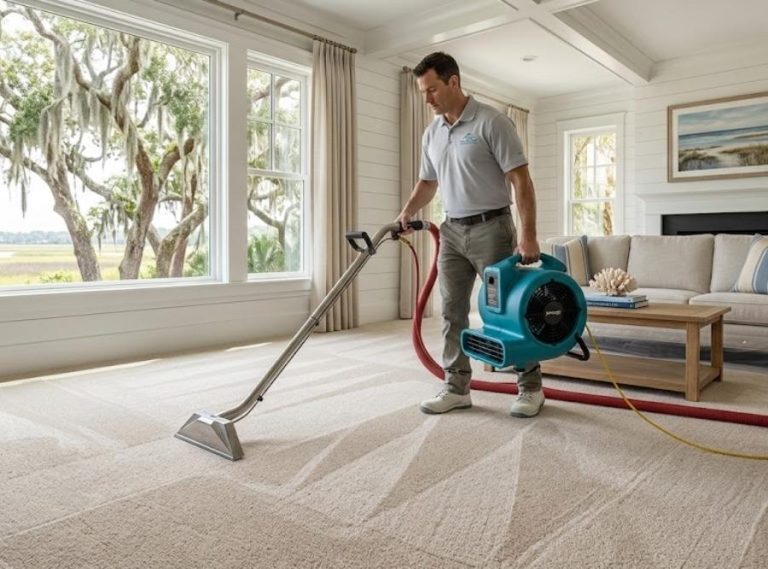
At Carolina Carpet Cleaning, we understand that moisture affects far more than carpet alone. Throughout Bluffton, from historic homes in Old Town to newer communities along Buckwalter Parkway and waterfront properties near the May River, we’ve seen how coastal humidity influences a home’s entire flooring system. Whether the concern involves hardwood, carpet, or hidden moisture after a leak, identifying and addressing the source is always the first step toward protecting the investment homeowners have made in their floors.
Kevin Snow, founder of Carolina Carpet Cleaning, has been serving Bluffton and the Lowcountry since 1993. As a hands‑on owner, he built the company’s reputation on eco‑friendly, low‑moisture cleaning methods that leave carpets dry in under an hour. His team specializes in carpet, tile, grout, hardwood, upholstery, and oriental rug care, delivering safe, detergent‑free results for families and businesses across Bluffton, Hilton Head Island, Beaufort, Hardeeville, and Ridgeland.