Why Does Carpet Take So Long to Dry in Bluffton’s Humidity?
Carpet takes longer to dry in Bluffton because the Lowcountry’s high humidity slows evaporation, making it harder for moisture to leave the carpet and its padding. When carpets are over-wet during cleaning or indoor airflow is limited, drying can stretch from several hours to multiple days, increasing the risk of musty odors and moisture-related problems.
You schedule a professional carpet cleaning expecting your home to feel fresh again by the evening, only to discover the carpet is still damp the next morning. By the second day, it still feels cool under your feet, the room seems unusually humid, and a faint musty odor may even begin to develop. For many homeowners in Bluffton, Hilton Head Island, and surrounding Lowcountry communities, this situation raises an understandable question: Is this normal, or is something wrong?
The answer depends on why the carpet is holding moisture. Bluffton’s coastal climate naturally slows evaporation because the air already contains a significant amount of moisture for much of the year. Afternoon thunderstorms, high summer dew points, homes near marshes, and warm temperatures all contribute to an environment where water simply doesn’t leave carpet as quickly as it would in a drier part of the country. While some additional drying time is expected, carpets that remain noticeably wet for days often indicate more than just humid weather.
One of the biggest misconceptions homeowners have is believing the carpet fibers are the only part that needs to dry. In reality, the visible surface is only one layer. Beneath it are the carpet backing, cushion or pad, and subfloor, all of which can retain moisture much longer than the carpet itself. A carpet may feel dry when touched by hand while hidden moisture remains trapped underneath, which is why proper extraction during cleaning is so important.
Why Bluffton’s Humidity Makes Carpet Dry More Slowly
Humidity affects one of the most important parts of the drying process: evaporation. Water naturally moves from a wet surface into the surrounding air, but when the air is already saturated with moisture, that process slows dramatically. Bluffton regularly experiences high humidity throughout much of the year, especially during late spring, summer, and early fall, making carpet drying noticeably slower than homeowners might expect.
Homes throughout neighborhoods like Hampton Lake, Rose Hill Plantation, Buckwalter, Palmetto Bluff, and Sun City Hilton Head often experience this challenge because of the region’s combination of warm temperatures and coastal moisture. Properties located near marshes, tidal waterways, or heavily wooded areas may also have naturally higher indoor humidity levels, even when the air conditioning is running.
Many homeowners assume lowering the thermostat will solve the problem. While air conditioners remove some humidity, their primary job is cooling the home. If an HVAC system is oversized, cycles too quickly, or has limited airflow in certain rooms, it may not remove enough moisture from the indoor air to significantly improve carpet drying. That’s why one room may dry relatively quickly while another remains damp well into the next day.
Vacation homes add another layer of complexity. Many Bluffton and Hilton Head homeowners leave their properties closed for days or weeks at a time. If freshly cleaned carpets are left inside a tightly sealed home without adequate air circulation or humidity control, drying slows considerably and lingering moisture becomes much more likely.
What Happens Beneath the Carpet Is Often More Important Than What You Can See
Professional carpet cleaning is about much more than cleaning the visible fibers. The real difference often lies in how effectively moisture is removed after the cleaning process is complete. Water that remains trapped in the carpet pad is one of the leading reasons carpets continue feeling damp long after the surface appears dry.
The carpet cushion acts almost like a sponge. Thicker or denser padding, which is common in many newer Bluffton homes, can retain moisture longer than homeowners realize. Older carpet pads can create similar problems because years of foot traffic compress the material, making water more difficult to extract efficiently. In both cases, moisture hidden beneath the surface can slowly migrate back upward, causing the carpet to feel damp again hours after it initially seemed dry.
We’ve also seen situations where one heavily used traffic lane dries much slower than the rest of the room. This often happens because years of walking compress carpet fibers and padding, changing how moisture moves through the material. Bedrooms with limited airflow, guest rooms with closed doors, and large living spaces filled with furniture can all experience uneven drying even after the same cleaning process.
Professional technicians understand these conditions because they see them regularly throughout the Lowcountry. Instead of assuming every carpet will dry at the same rate, experienced cleaners evaluate carpet type, fiber construction, padding, indoor humidity, airflow, and the home’s overall environment before determining the best cleaning approach.
Common Mistakes That Can Keep Carpets Wet Longer
Most homeowners want to help the drying process, but some well-intentioned efforts can actually delay it. Closing the house completely while leaving for work or vacation is one example. Without fresh air movement or proper humidity control, moisture has nowhere to go, allowing dampness to linger inside the carpet and pad.
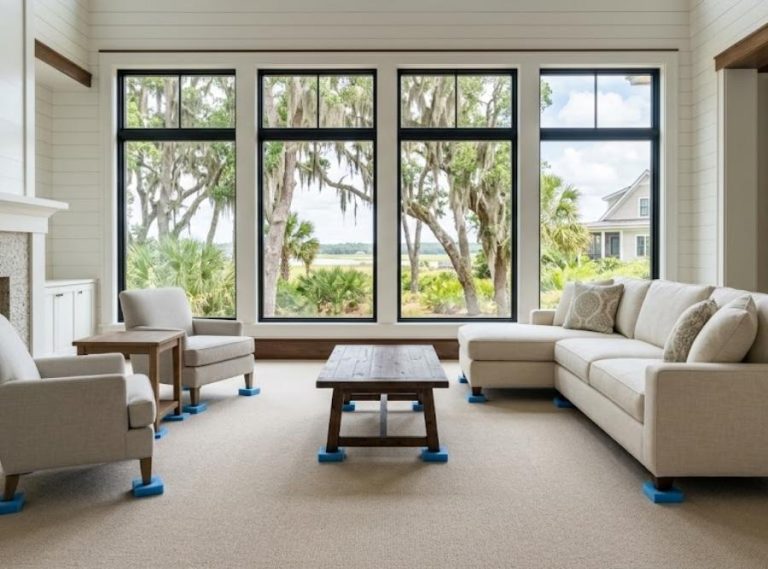
Another common mistake is replacing furniture too quickly. Furniture legs placed back onto damp carpet can trap moisture underneath while also creating stains or finish transfer onto freshly cleaned fibers. Similarly, placing area rugs back over damp carpet prevents evaporation and creates pockets where moisture remains concentrated.
Some homeowners also assume the carpet is fully dry simply because the surface no longer feels wet. Unfortunately, moisture trapped beneath the carpet can remain for many additional hours or even days. This hidden moisture often explains why a musty odor suddenly appears after the carpet seemed to be drying normally.
Using excessive heat can also create problems. Space heaters positioned directly against carpet rarely solve the underlying issue and may dry only the surface while leaving deeper moisture untouched. A better approach is improving overall air circulation with properly positioned fans while maintaining consistent air conditioning and, when necessary, using a dehumidifier to lower indoor humidity.
When Slow Drying Becomes a Bigger Concern
Not every slow-drying carpet represents an emergency, but prolonged moisture should never be ignored. Once moisture remains trapped beyond normal drying times, conditions become much more favorable for mildew growth, odor development, and deterioration beneath the carpet where homeowners cannot easily see it.
One of the earliest warning signs is a musty smell that becomes stronger instead of weaker over time. Homeowners sometimes assume this is simply the cleaning solution drying, but persistent odors often indicate moisture is remaining inside the pad or subfloor. If ignored, these odors become increasingly difficult to eliminate because the source isn’t on the carpet surface anymore.
Extended moisture can also lead to stains reappearing after they initially disappeared during cleaning. This process, often called wicking, occurs when dissolved soils or residues travel upward with evaporating moisture from deeper within the carpet. Many homeowners believe the stain “came back,” when in reality the remaining moisture carried hidden contaminants back to the surface.
In more severe situations, prolonged dampness can affect carpet backing, adhesives, or even wood subfloors beneath the installation. While these outcomes are less common after proper professional cleaning, they become much more likely when carpets are heavily saturated, poorly extracted, or left wet for several days without intervention.
Why Professional Cleaning Methods Make a Significant Difference
The amount of water used during cleaning is only part of the equation. What matters just as much is how much water is removed before the technician leaves your home. Thorough extraction is one of the most important factors influencing drying time, yet it is often overlooked when homeowners compare carpet cleaning companies.
At Carolina Carpet Cleaning, the goal isn’t simply to leave carpets looking clean. It’s to remove embedded soil while controlling moisture so carpets dry efficiently and safely in Bluffton’s humid environment. Every home presents different conditions, whether it’s a marshfront property in Palmetto Bluff, a family home near Buckwalter Parkway, or a vacation property on Hilton Head Island that may remain closed between visits. Understanding those conditions helps determine the most appropriate cleaning approach rather than applying the same process to every carpet.
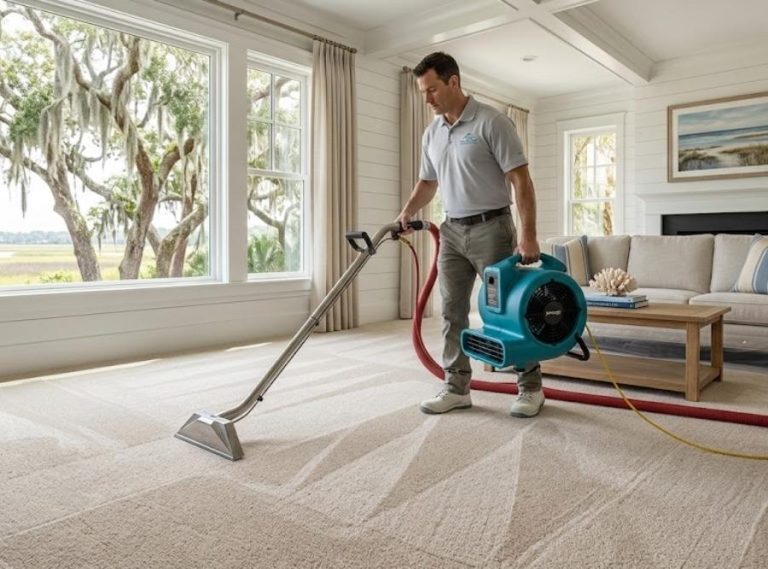
Professional equipment also provides stronger extraction than most consumer rental machines. While rental units often leave behind excess moisture because of limited vacuum power, commercial-grade equipment is designed to remove significantly more water during the cleaning process. That difference alone can shorten drying times and reduce the likelihood of odors, wicking, or moisture-related concerns.
Equally important is experience. Carpet fibers, padding, traffic patterns, indoor humidity, and local environmental conditions all influence how a carpet should be cleaned. A technician who regularly works throughout Bluffton, Beaufort, Okatie, and Hilton Head understands these regional factors and can adjust cleaning methods accordingly instead of relying on a one-size-fits-all approach.
Protecting Your Carpet Means Paying Attention to Drying Time
Carpet cleaning doesn’t end when the equipment is packed away. Proper drying is part of protecting your flooring investment, maintaining a healthier indoor environment, and preventing avoidable moisture problems that can become much more expensive if ignored.
If your carpet is still noticeably wet after 24 to 48 hours, develops a worsening musty odor, or feels squishy beneath the surface, it’s worth having the situation evaluated before hidden moisture creates larger issues. Addressing excess moisture early is often far simpler and less expensive than dealing with damaged carpet padding, persistent odors, or flooring replacement later.
For homeowners throughout Bluffton, Hilton Head Island, Beaufort, Okatie, and the surrounding South Carolina Lowcountry, Carolina Carpet Cleaning provides professional carpet cleaning focused on thorough soil removal, responsible moisture control, and long-term carpet care. If you have concerns about slow-drying carpets or are ready for a professional cleaning designed for the Lowcountry’s unique climate, their team is happy to answer your questions and recommend the best solution for your home.
Kevin Snow, founder of Carolina Carpet Cleaning, has been serving Bluffton and the Lowcountry since 1993. As a hands‑on owner, he built the company’s reputation on eco‑friendly, low‑moisture cleaning methods that leave carpets dry in under an hour. His team specializes in carpet, tile, grout, hardwood, upholstery, and oriental rug care, delivering safe, detergent‑free results for families and businesses across Bluffton, Hilton Head Island, Beaufort, Hardeeville, and Ridgeland.