Is Steam Cleaning a Bad Idea in High-Humidity Climates like the Lowcountry?
No, steam cleaning is not inherently a bad idea in Bluffton’s humid climate, but improper moisture management can create problems if too much water is left behind or the carpet doesn’t dry efficiently. Professional hot water extraction combined with thorough moisture removal, proper airflow, and controlled drying can safely and effectively clean carpets, even in the South Carolina Lowcountry.
One of the most common concerns homeowners have after scheduling a carpet cleaning appointment is whether the carpet will actually dry. That concern becomes even more understandable in Bluffton, where warm temperatures, coastal humidity, afternoon thunderstorms, and high dew points often make the air feel damp before the day has fully begun. If you’ve ever walked across a carpet that still felt cool or slightly clammy the day after it was cleaned, it’s easy to wonder whether steam cleaning simply isn’t suited for life in the Lowcountry.
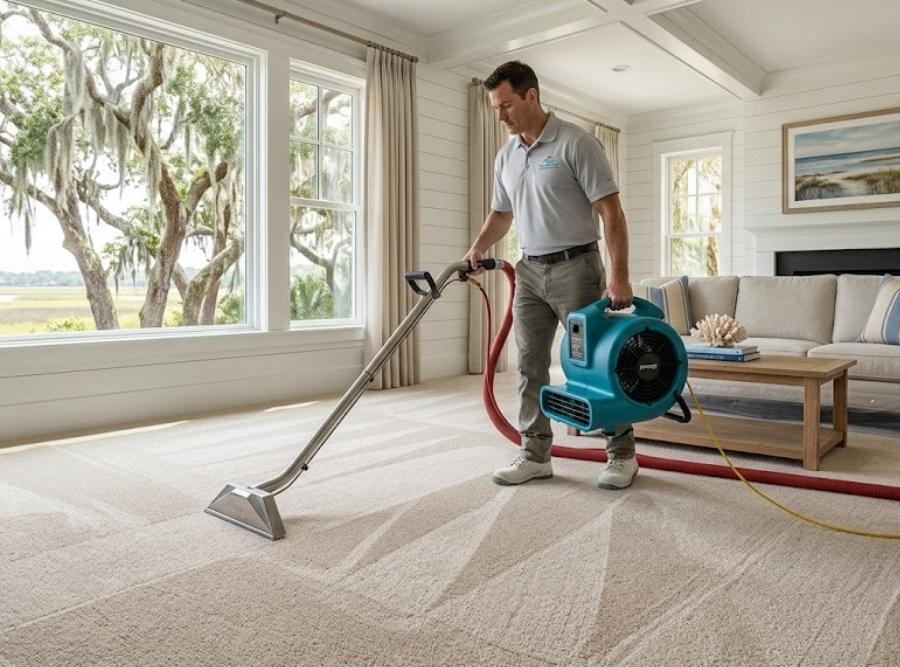
The answer is more nuanced than most people expect because the term “steam cleaning” is often misunderstood. While homeowners commonly use the phrase to describe professional carpet cleaning, most reputable companies are actually performing hot water extraction, not cleaning carpets with steam alone. Hot water is injected into the carpet to loosen embedded soil before powerful extraction equipment immediately removes the water along with dirt, oils, allergens, and other contaminants. The effectiveness of the process depends far less on how much water is introduced than on how efficiently that water is removed.
One of the biggest misconceptions we hear is that humidity automatically makes professional carpet cleaning risky. In reality, humidity simply changes how the drying process should be managed. A properly cleaned carpet should never remain saturated for days because of the cleaning method itself. When carpets stay wet far longer than expected, the underlying issue is usually related to excessive moisture application, inadequate extraction, poor airflow, existing indoor humidity problems, or a combination of several factors rather than the concept of hot water extraction itself.
We’ve cleaned carpets throughout Bluffton for years, from historic homes near Calhoun Street to newer communities along Buckwalter Parkway, Hampton Lake, and Berkeley Hall. One thing we’ve consistently observed is that two homes sitting only a few miles apart can experience dramatically different drying times depending on their construction, HVAC performance, indoor humidity, carpet type, and ventilation. That’s why experienced carpet cleaning is never simply about cleaning the fibers—it’s about understanding how moisture behaves inside each individual home.
Bluffton’s Climate Changes the Drying Process—Not the Cleaning Process
If the exact same carpet were cleaned on a dry afternoon in Arizona and again during a humid July morning in Bluffton, the carpet in Arizona would almost certainly dry more quickly. That doesn’t mean the cleaning process itself was better. It simply means the surrounding air was able to accept moisture more efficiently.
Drying is governed by evaporation, and evaporation depends on the relationship between moisture inside the carpet and moisture already present in the surrounding air. Bluffton’s coastal climate naturally slows this process because the air frequently contains a significant amount of moisture before carpet cleaning even begins. High relative humidity reduces the atmosphere’s ability to absorb additional moisture, meaning every drop of water remaining in the carpet after cleaning takes longer to leave the fibers, backing, and cushion.
This is why professional moisture extraction becomes so important in coastal environments. Every gallon of water successfully removed during cleaning is one less gallon that must evaporate naturally afterward. Experienced technicians understand that they aren’t simply cleaning carpet—they’re managing the drying process from the very beginning. Powerful extraction equipment, proper cleaning techniques, and careful attention to water recovery become even more valuable in Bluffton than they might in drier parts of the country.
We’ve noticed that homeowners often judge drying progress by touching the surface of the carpet. While understandable, that can sometimes create a false sense of security. The upper fibers may feel completely dry while small amounts of moisture remain trapped deeper within the carpet backing or cushion. Conversely, the surface may still feel slightly cool even though the remaining moisture level is perfectly normal and the carpet is drying exactly as expected. Surface feel alone doesn’t always tell the entire story.
One professional observation we’ve made repeatedly is that homeowners tend to blame humidity for every extended drying time, when the real explanation is often a combination of factors. Homes with older HVAC systems, limited air circulation, thick carpet padding, or closed-up vacation properties frequently dry more slowly regardless of the outdoor weather. Humidity contributes to the challenge, but it usually isn’t acting alone.
Why Some Carpets Dry Beautifully While Others Develop Problems
One question we frequently hear is why one homeowner can have their carpets cleaned with no issues while another experiences lingering dampness, musty odors, or stains that seem to return a few days later. The answer usually lies in what happens beneath the visible carpet fibers rather than on the surface itself.
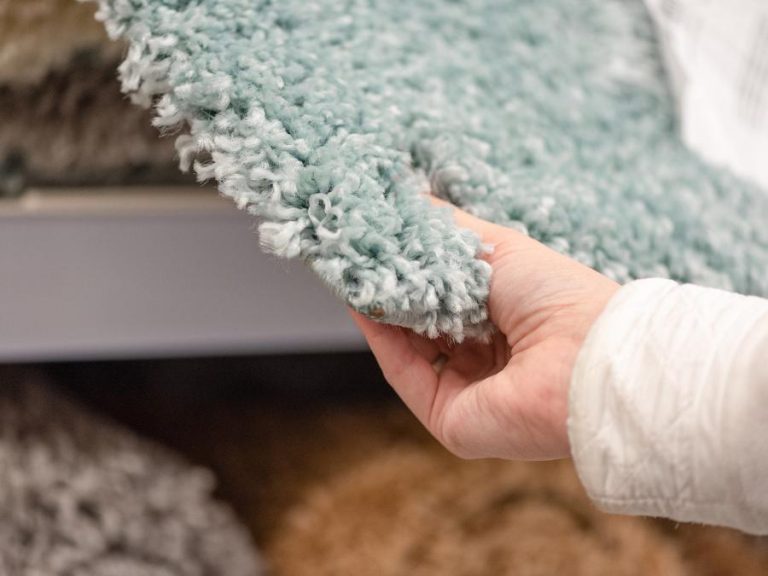
Every carpet consists of multiple layers working together. Above the surface are the fibers everyone sees and walks on. Beneath those fibers are the backing materials, the carpet cushion or pad, and ultimately the subfloor supporting everything underneath. When excessive moisture penetrates beyond the fibers without being adequately extracted, each of those layers may retain water for different lengths of time. In Bluffton’s humid environment, that drying process naturally slows even further.
Older carpet padding is particularly susceptible to prolonged moisture retention. As padding ages, it gradually loses some of its original structure, making it more likely to hold moisture after cleaning or spills. Thick, high-density padding, while comfortable underfoot, can also extend drying time because there is simply more material capable of retaining water. This doesn’t make thicker padding a poor choice for comfort, but it does mean moisture management becomes increasingly important during professional cleaning.
Another factor many homeowners don’t realize is that embedded soil itself affects drying. Carpets carrying years of accumulated oils, beach sand, pet residue, food spills, and organic debris often require more thorough cleaning than lightly soiled carpets. Those contaminants don’t just make the carpet dirty—they also interfere with how water moves through the fibers during cleaning and extraction. In many cases, the carpet isn’t taking longer to dry because it was cleaned; it’s taking longer because the contamination made efficient extraction more difficult.
We’ve seen this frequently in Bluffton vacation homes and rental properties. A carpet may appear reasonably clean after regular vacuuming between guests, yet years of sunscreen, beach sand, damp towels, and heavy foot traffic have created layers of embedded contamination below the surface. Cleaning those carpets properly often requires more careful extraction and drying management than homeowners initially expect.
Most Post-Cleaning Problems Are Moisture Management Problems
When homeowners say, “Steam cleaning ruined my carpet,” the cleaning method is rarely the actual culprit. More often, the problems that follow can be traced back to moisture remaining in the carpet longer than it should.
One example is soil wicking, where stains appear to disappear during cleaning only to return after the carpet dries. This happens because moisture carries dissolved contaminants upward from deeper within the carpet or pad as it evaporates. Another common complaint is a musty odor that develops a day or two after cleaning. In many situations, the smell isn’t being created by the cleaning itself. Instead, lingering moisture has remained in contact with organic material long enough for odor-producing microbial activity to begin.
We’ve also encountered homeowners who believed professional cleaning permanently damaged their carpet because it felt sticky after drying. In reality, sticky carpet is often the result of detergent residue left behind during previous cleanings or consumer rental machine use rather than the most recent professional service. Residual detergents continue attracting soil long after the cleaning has finished, causing carpets to become dirty again much more quickly than expected.
These examples all point to the same conclusion: the success of carpet cleaning in Bluffton isn’t determined by whether hot water extraction is used. It’s determined by how effectively moisture is controlled before, during, and after the cleaning process. Understanding that difference is one of the reasons experienced carpet cleaning companies focus just as much on drying as they do on washing.
Good Carpet Cleaning Doesn’t End When the Cleaning Is Finished
Many homeowners assume that once the technician packs up the equipment, the job is complete. In reality, one of the most important phases of professional carpet cleaning is just beginning. The hours immediately following the cleaning often determine whether the carpet dries efficiently or develops the lingering dampness, odors, or recurring stains that homeowners mistakenly blame on the cleaning method itself.
Professional carpet cleaning should always include a drying strategy. In Bluffton, that usually means thinking beyond simply removing visible water. Air circulation, indoor humidity, HVAC performance, and even the layout of the home all influence how quickly residual moisture leaves the carpet. A home with strong air conditioning, ceiling fans, and healthy airflow may dry significantly faster than a nearly identical home where doors remain closed, furniture blocks circulation, and the HVAC system struggles to control humidity.
We’ve noticed this especially in vacation homes that sit vacant between visits. Owners often close the property immediately after cleaning, assuming everything will finish drying naturally. Unfortunately, a tightly sealed home without adequate air movement can trap humid air inside, slowing evaporation long after the technician has left. The carpet may appear dry when viewed from above, yet small amounts of moisture can remain below the surface much longer than expected.
One thing we’ve learned after cleaning carpets throughout Bluffton is that drying should never be left to chance. Experienced professionals don’t simply remove dirt—they create conditions that allow the carpet to return to a stable, dry state as efficiently as possible.
Hot Water Extraction and Low-Moisture Cleaning Both Have Their Place
Another misconception we hear regularly is that one carpet cleaning method is universally better than another. In reality, the best approach depends on the condition of the carpet, the amount of embedded soil, how quickly the space needs to be used again, and the environment in which the carpet exists.
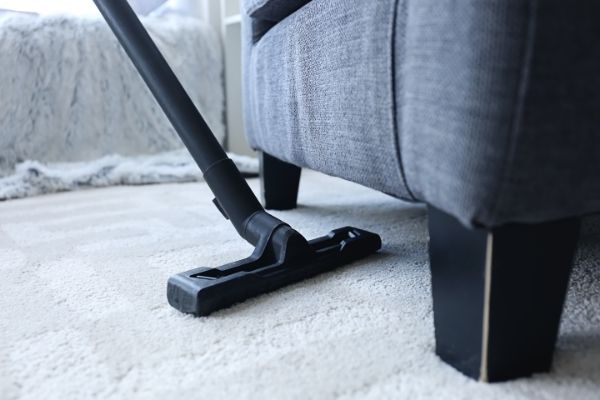
Hot water extraction remains one of the most effective methods for removing deeply embedded dirt, allergens, oils, and contaminants from residential carpet. When performed correctly with professional equipment, powerful extraction removes the vast majority of the water introduced during the cleaning process. This allows for a deep restorative cleaning that reaches below the surface where vacuuming simply cannot.
Low-moisture cleaning methods also have an important role, particularly in certain commercial settings or situations requiring exceptionally fast turnaround. Offices, retail spaces, and some hospitality environments may benefit from low-moisture encapsulation cleaning because the carpets can often return to service much sooner. These methods use considerably less water and rely on specialized cleaning chemistry rather than deep flushing of the carpet.
That doesn’t mean low-moisture cleaning automatically replaces hot water extraction. Instead, many experienced carpet care professionals view the two methods as complementary rather than competitive. A lightly soiled commercial carpet may respond beautifully to a low-moisture maintenance program, while a residential carpet carrying years of embedded soil, pet contamination, or heavy organic buildup often benefits from the deeper restorative capabilities of professional hot water extraction.
We’ve found that homeowners sometimes focus so heavily on the amount of water being used that they overlook the condition of the carpet itself. Choosing the wrong cleaning method for the situation can be just as problematic as using too much moisture. The objective isn’t simply to keep the carpet dry—it’s to clean it thoroughly while managing moisture responsibly.
Small Mistakes After Cleaning Can Extend Drying Time Significantly
Professional cleaning is only part of the equation. The hours immediately afterward also influence how successfully the carpet dries, particularly during Bluffton’s humid summer months.
One of the most common mistakes homeowners make is opening windows in hopes of “airing out” the house. That advice may work in dry climates, but along the South Carolina coast it often has the opposite effect. If outdoor humidity is higher than the indoor humidity, opening windows simply introduces additional moisture into the home, slowing evaporation rather than accelerating it. Running the air conditioning while maintaining good indoor airflow is usually a much more effective strategy than relying on humid outdoor air.
We’ve also seen homeowners turn the air conditioning off after the cleaning to reduce energy costs while they leave the house for the day. Unfortunately, doing so allows indoor humidity to rise precisely when the carpet needs controlled drying conditions. Air conditioning isn’t simply cooling the home—it also removes moisture from the indoor air, making it an important part of the drying process.
Furniture placement is another overlooked factor. Returning heavy furniture to damp carpet too soon can trap moisture beneath legs and bases, slowing airflow to those areas. That’s one reason professional cleaners often use protective tabs or blocks beneath furniture until the carpet has completely dried.
Walking heavily on damp carpet, repeatedly applying additional spot cleaners, or renting consumer carpet machines to “touch up” remaining stains can also complicate the drying process. We’ve occasionally visited homes where a minor spill had already been treated three or four different ways before professional service arrived. Each additional application introduced more moisture and detergent into the carpet, making complete drying even more difficult.
One professional observation we’ve made repeatedly is that homeowners often become impatient during the final stages of drying. If the carpet still feels slightly cool several hours later, they assume something has gone wrong. In many cases, the carpet is simply completing the final stages of moisture release exactly as expected. Cool doesn’t necessarily mean wet, just as dry on the surface doesn’t always mean the deeper layers have fully stabilized.
Knowing When Slow Drying Signals a Bigger Problem
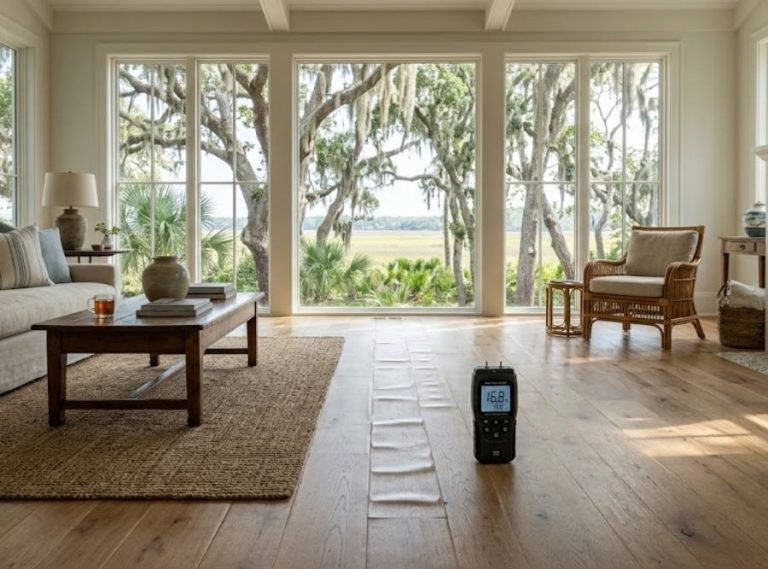
While slower drying is normal during periods of high humidity, there comes a point where additional investigation becomes appropriate. A carpet that remains noticeably wet beyond 24 to 48 hours, particularly when proper airflow and air conditioning have been maintained, deserves closer attention.
Persistent dampness may indicate that moisture has reached the carpet pad, extraction was insufficient, a plumbing leak exists beneath the flooring, or the home has a broader indoor humidity issue unrelated to the carpet cleaning itself. Vacation homes and waterfront properties can be especially vulnerable because elevated indoor humidity sometimes develops gradually over weeks before anyone notices.
We’ve also found that recurring musty odors appearing every morning, stains that repeatedly wick back to the surface after drying, or visible discoloration around baseboards often point toward moisture that extends deeper than the carpet fibers alone. Those situations shouldn’t simply be masked with deodorizers or fragrances. They deserve a proper evaluation to determine whether the moisture source has been fully addressed.
The good news is that these situations are far less common when professional extraction, proper moisture management, and post-cleaning drying procedures are all performed correctly. Most carpets cleaned by experienced professionals dry without developing mold, mildew, or long-term moisture problems, even in Bluffton’s humid coastal climate.
It’s Not Bluffton’s Humidity That Determines Success—It’s How the Moisture Is Managed
So, is steam cleaning a bad idea in Bluffton?
Not at all. The real issue isn’t humidity, and it isn’t hot water extraction. The real issue is whether moisture is responsibly controlled throughout the entire cleaning and drying process.
At Carolina Carpet Cleaning, we understand that cleaning carpet in the Lowcountry requires more than simply removing dirt. Every home presents its own combination of humidity, airflow, carpet construction, occupancy, and environmental conditions. Whether we’re cleaning a family home in Hampton Hall, a waterfront property near the May River, a vacation rental in Palmetto Bluff, or a residence along Buckwalter Parkway, our approach focuses on delivering the deep cleaning homeowners expect while carefully managing the moisture that Bluffton’s climate naturally introduces.
When hot water extraction is performed with professional equipment, experienced technique, and a clear understanding of coastal drying conditions, it remains one of the safest and most effective ways to restore carpet. Proper extraction, thoughtful drying practices, and attention to indoor humidity allow homeowners to enjoy cleaner, fresher carpets without the lingering dampness and odors that give “steam cleaning” an undeserved reputation.
Kevin Snow, founder of Carolina Carpet Cleaning, has been serving Bluffton and the Lowcountry since 1993. As a hands‑on owner, he built the company’s reputation on eco‑friendly, low‑moisture cleaning methods that leave carpets dry in under an hour. His team specializes in carpet, tile, grout, hardwood, upholstery, and oriental rug care, delivering safe, detergent‑free results for families and businesses across Bluffton, Hilton Head Island, Beaufort, Hardeeville, and Ridgeland.